Passive Income
On one of my first dates with my now husband, he mentioned that he wanted to be in a position where his money worked for him, not him working for money. I’ve thought about this a lot and many times wished I had pursued the conversation more fully because though I had a concept of what he meant I didn’t know the intricacies of how to implement. Living overseas made things somewhat more complicated because the tax systems are different, and moving money between international locations was far from as easy as it is now.
Fast forward many years and I’ve been digging in to the term and what it can mean for us. The idea is that you invest your money in places where income will be generated. This is all pretty basic stuff for people with finance backgrounds, but for those of us without that advantage we need to understand and get started on this as early as possible to ensure a financially secure retirement.
Passive income is income that you receive but don’t have to do work to receive. Some of the categories of passive income are dividends, interest, or rental income. Dividends and interest are typically generated from investments either in stocks or mutual funds. Interest is generated from bank accounts, usually in the form of high yield savings accounts (HYSA) and investing in certificates of deposit (CDs) or treasury, or other bonds. Rental income is generated from owning some sort of property that you rent out to others.
Many people who “FIRE” or are financially independent and retire early, have enough money invested that they can live off of dividends and interest, and possibly some rental income. My goal is to get to that place. My numbers aren’t important to anyone but me, so I won’t be sharing the details of our financial position, but the key to making the money work for you concept be successful, is to know exactly how much you spend and then set your goal to get to the point that your passive income fully covers your expenses.
Let’s take an example. Say you’ve figured out that your monthly expenses are $5,000, so annually that’s $60,000 and if you wanted to retire and not touch your principal, you would need $60,000 in passive income. Perhaps you would have a rental that provides $24,000 a year, after expenses. That leaves $36,000. Maybe you have done a good job saving and you have $100,000 in cash that you like to have in case of emergencies and because you don’t want to have to sell your investments in a downturn. If you have that money invested in a HYSA at 4%, you would be making another $4,000 a year. That takes the amount that you need down to $32,000. You’re now down to only having to make about half of what your expenses are. If you have funds invested in the market, you might get another few thousand dollars a year in dividends, reducing further the amount you need to cover your expenses. If you are at retirement age, social security could help plug the gap. If you’re not at retirement age, a part-time job may bring in enough funds to cover the gap.
I know it seems hard, impossible at times to even cover rent, and put food on the table, but if there is any way at an early age to begin to put away small amounts of money, DO IT! Your future self will be immensely pleased that you did.
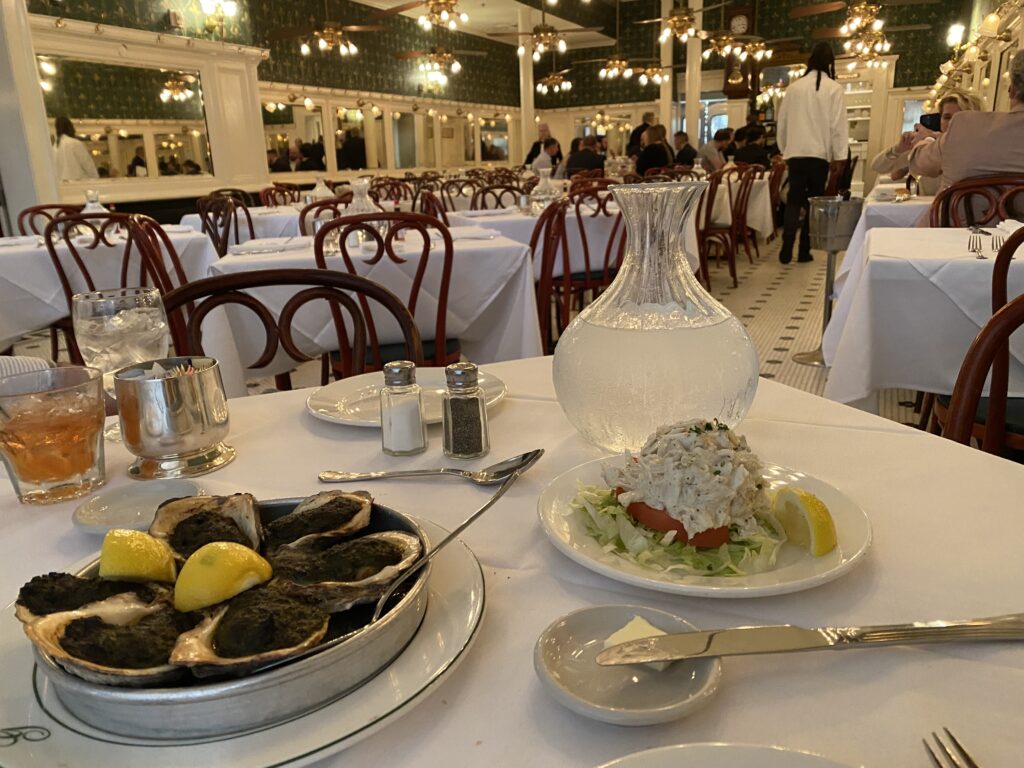
This picture was taken at Galatoire’s in New Orleans. I was fortunate to be invited to speak at a conference held in NOLA and hubby was able to accompany me. I thought the crab salad was outstanding but I wasn’t a fan of this particular version of Oysters Rockefeller. We went for a late lunch and there was no one in the restaurant but us and a large work group.
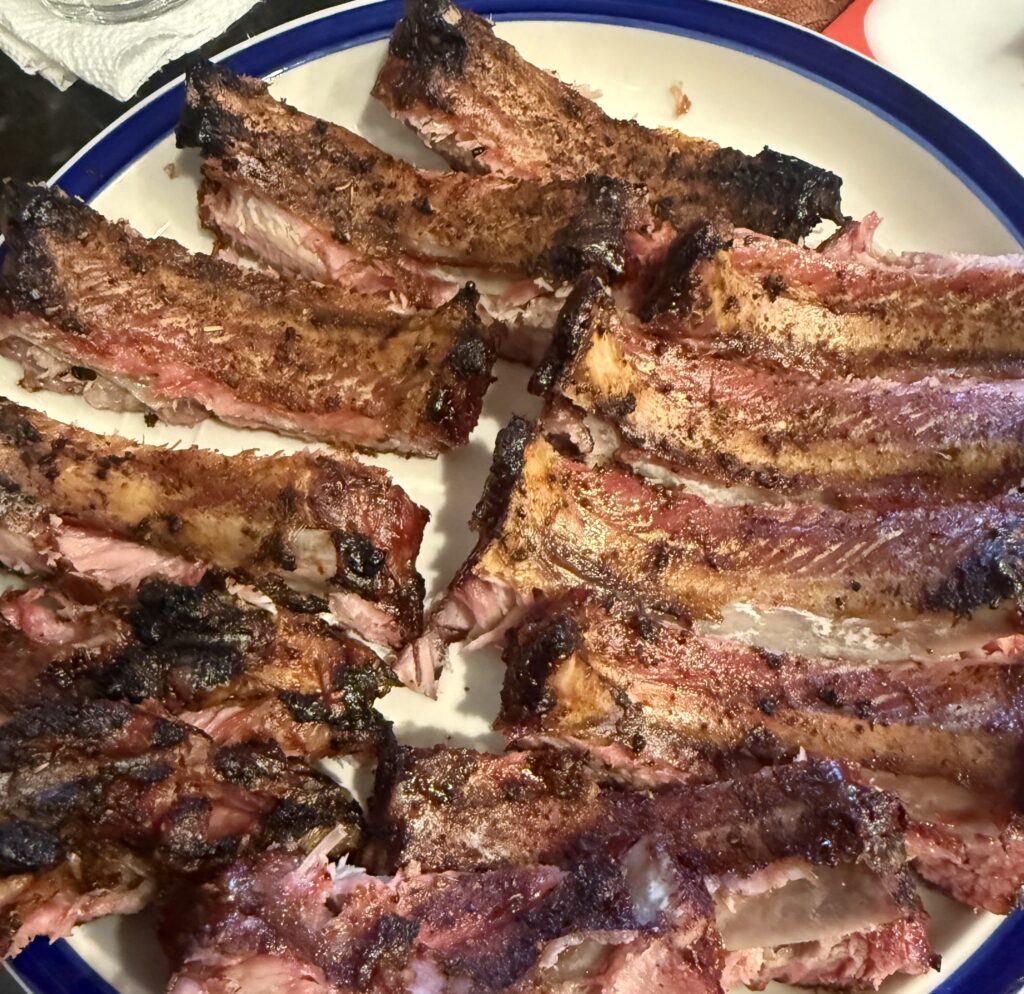
Eating out is fun, and we do way too much of it, but eating at home is great too and a good way to save money. Here is a platter of ribs that I smoked on our bullet smoker for Father’s Day. My sister in law tasted them and called me the queen of ribs. Hey, I’ll take it.